
| Switch Type: Tactile | Mount: Plate Mount (3-pin) | Spring: | Price: |
| Top Housing: | Bottom Housing: | Stem: | Factory Lubed: |
| Actuation Point: | 1.8mm | Actuation Point: | 1.68mm |
| Actuation Force: | Actuation Force: | 44.5gf | |
| Total Travel: | Total Travel: | 3.66mm | |
| Peak Tactile Point: | Peak Tactile Point: | 0.61mm | |
| Peak Tactile Force: | Peak Tactile Force: | 57.0gf | |
| Reset Point: | Reset Point: | 1.65mm | |
| Bottom-out Force: | Bottom-out Force: | 64.5gf | |
| Stem Length: | |||
The Roccat Titan (Tactile) is a tactile gaming switch with a higher actuation point (1.8mm) and shorter travel (3.6mm) compared to the competition at the time. Roccat claims this leads to a 20% faster input and an ever-faster response due to the keycaps weighing 50% less than standard. The Titan Tactile switch is manufactured by TTC.
TL;DR
They’re basically a Cherry MX Brown clone with a slightly higher actuation point and a slightly shorter travel. They’re clearly from a time when switch innovation was stagnating as there was no discernible difference between the Roccat Titan Tactile and the Cherry MX Brown in terms of key feel, let alone in gaming.
Additionally, Roccat doesn’t sell this switch as a standalone, so you’re forced to buy one of their keyboards to try them out. I’m here to tell you that you aren’t missing out on anything special.
Smoothness: 7/10
On-centre keypresses are very smooth with almost no scratchiness or inconsistencies at very slow keypresses.
Off-centre keypresses are a little bit scratchier with more noticeable inconsistencies, but only at very slow keypresses.
Overall, they’re a decently smooth switch. An upgrade from the Cherry MX Brown for sure which would’ve been impressive at the time, but it isn’t special now in the current market.
Weighting: 6/10
According to Roccat, these switches have an actuation point of 1.8mm and a total travel of 3.6mm.
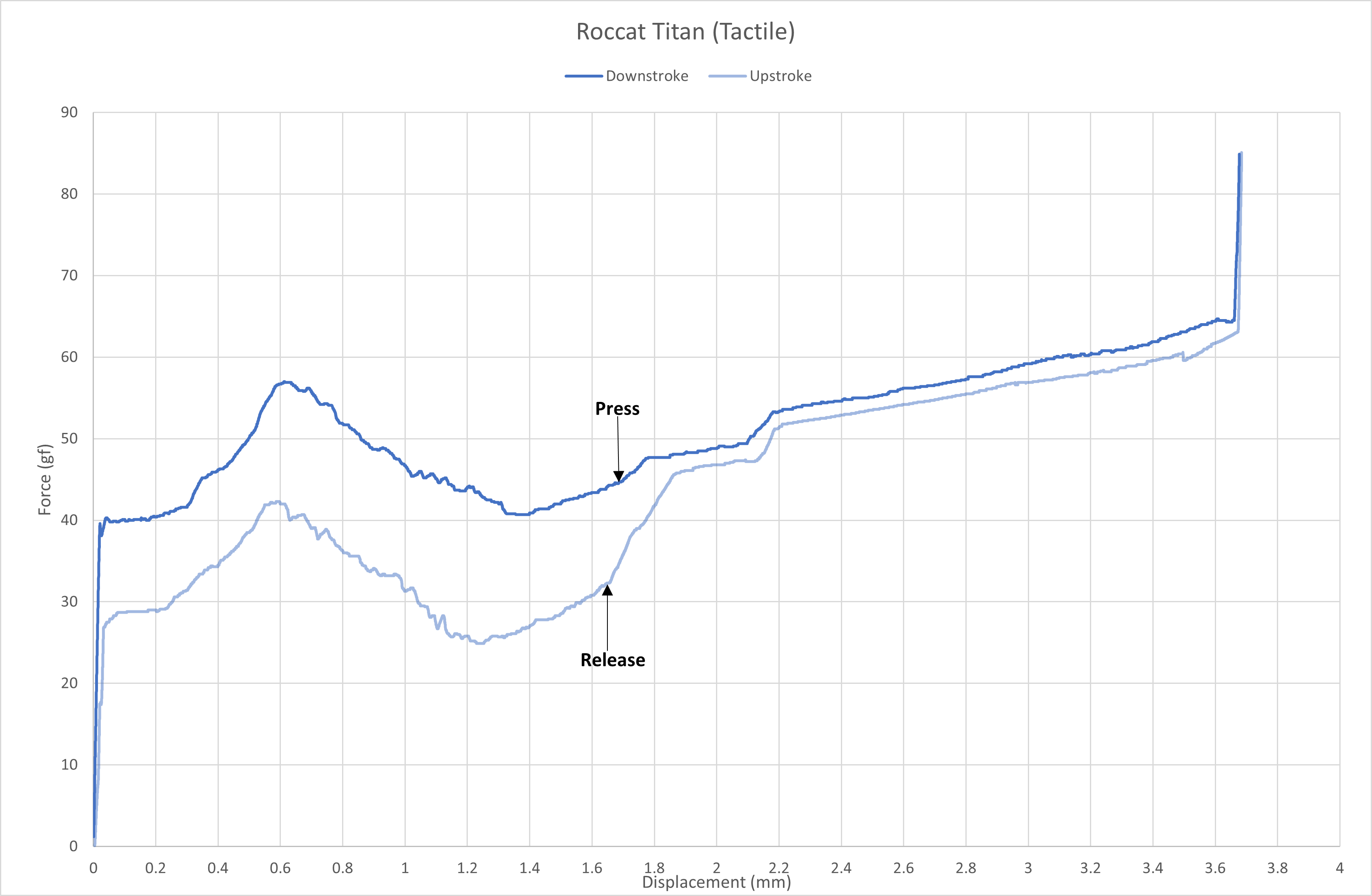
Roccat Titan Tactile force curve.
As you can see from the force curve above, the Roccat Titan (Tactile) were within its outlined specs.
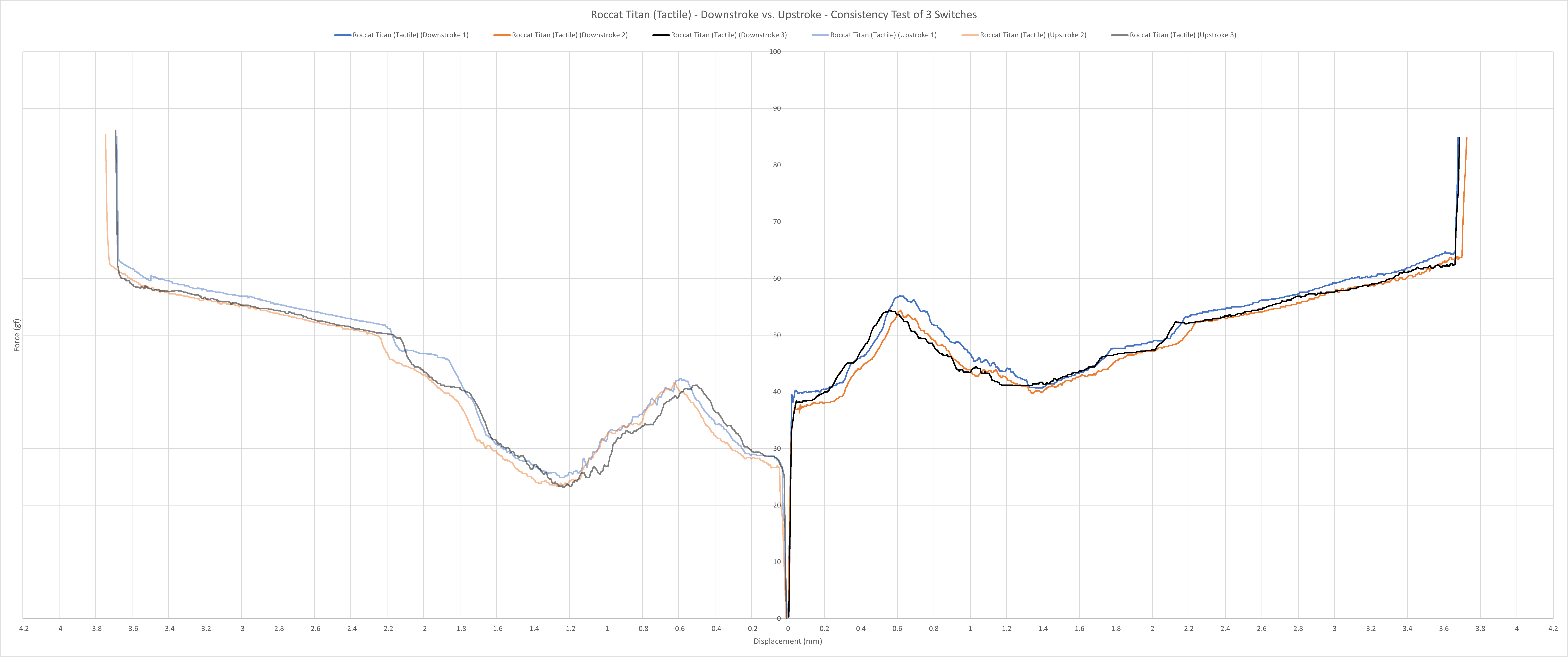
Roccat Titan Tactile consistency force curve.
They were also very consistent with neither of the three switches showing major deviations from one another. TTC did a great job here.
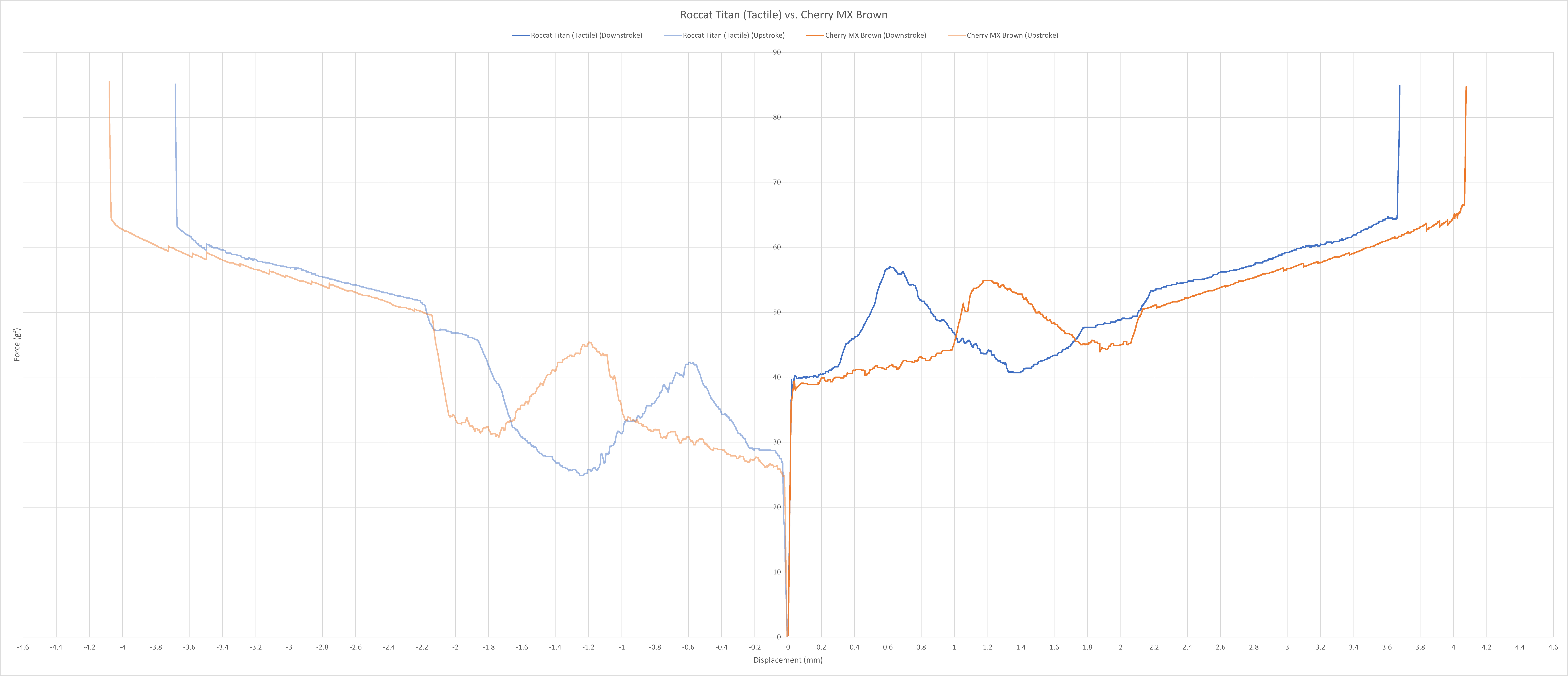
Roccat Titan Tactile vs. Cherry MX Brown force curve.
The above force curve shows a comparison between the Roccat Titan (Tactile) and the Cherry MX Brown. The Titan switch has an earlier tactile bump and less total travel. Roccat’s claims are correct with the Titan switch travelling just over 3.6mm which is within tolerance.
The Titan’s tactility is also slightly stronger and sharper compared to the MX Brown, although this barely noticeable when using them.
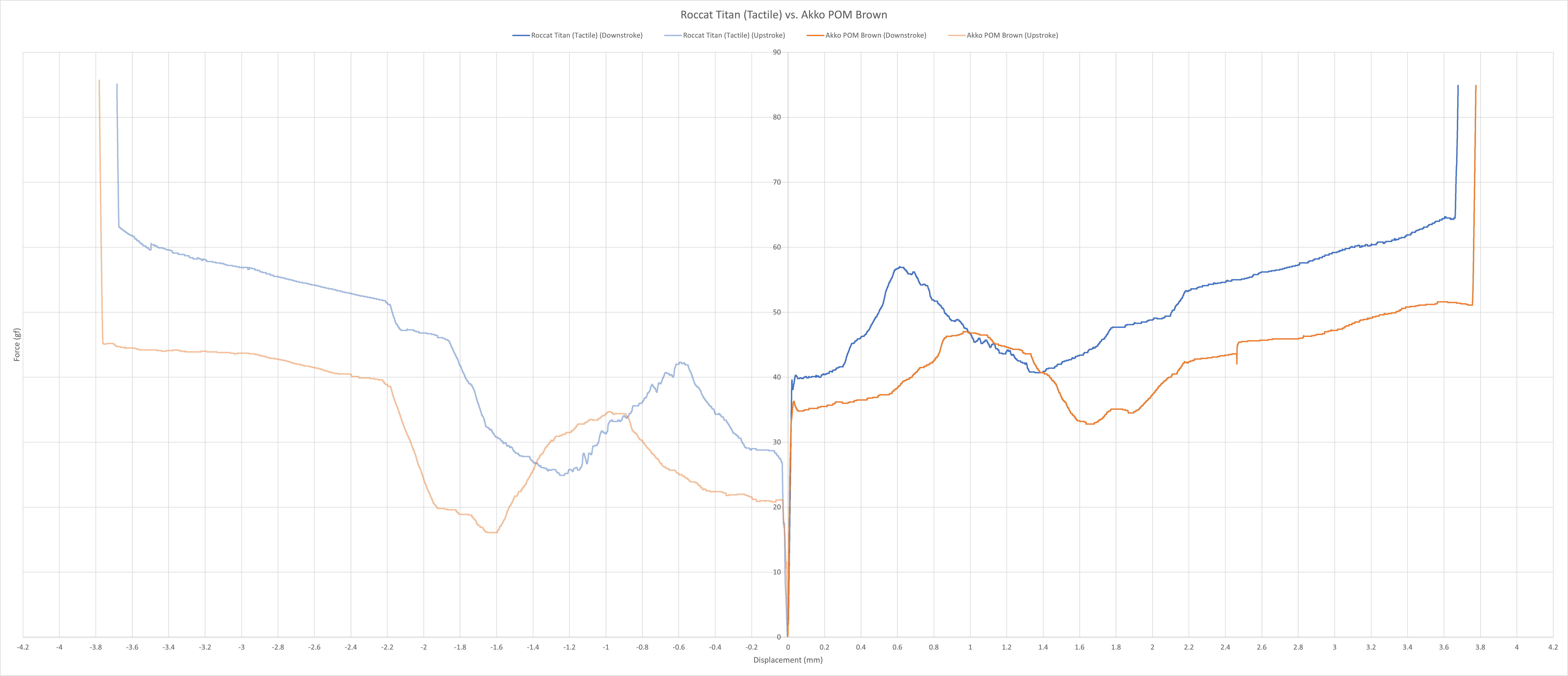
Roccat Titan Tactile vs. Akko POM Brown force curve.
The above force curve shows a comparison between the Roccat Titan (Tactile) and the Akko POM Brown. The two switches don’t look similar at first, but both their tactile strength and sharpness are very similar despite them having different weightings.
Overall, the Titan switches have a light weighting with excellent levels of consistency. They’re too light for my preferences, but they’re a decent alternative to the Cherry MX Brown as long as you don’t mind spending your money on a Roccat keyboard.
Sound: 4/10
They sound sub-par. I think this is due to the cheaply made keycaps and the open “floating” switch design of the keyboard. The stabilizers are quite rattily and some of the switches ping on the upstroke too.
Overall, sound was definitely not a top priority when Roccat was designing this keyboard. Then again, this was the case with many gaming keyboards of its time.
Typing Performance: 5/10
They’re consistency is where they really shine, but apart from that, they feel pretty much like any other ‘brown’ switch on the market. They’re lightly weighed and feature a weak tactile bump.
Additionally, I’m not a fan of lightly weighted switches such as these, so these fall outside my preferences.
Overall, Roccat didn’t innovate anything new here. But they are for those looking for a decent Cherry MX Brown alternative.
Gaming Performance: 6/10
I couldn’t feel their tactility during slow or fast-paced gaming which was to be expected for a Cherry MX Brown clone.
However, just like with typing, their consistency was top-notch which made gaming that much more pleasant unlike the Cherry MX Brown it’s competing with all its scratchiness and inconsistencies.
Overall, these personally wouldn’t be my top choice for gaming, but I have to admit that they’re far from the worst out there.
Final Score = 28/50 (56%)