
| Switch Type: Linear |
| Actuation Point (mm): | 1.5 | Actuation Point (mm): | 1.59 |
| Actuation Force (gf): | 45 | Actuation Force (gf): | 46.0 |
| Total Travel (mm): | 3.2 | Total Travel (mm): | 3.22 |
| Reset Point (mm): | Reset Point (mm): | 1.50 | |
| Bottom-out Force (gf): | Bottom-out Force (gf): | 65.5 | |
TL;DR
These were a reasonable upgrade from a Cherry MX Red and certainly from a cheap rubber dome. These were smoother and more consistent throughout. Although with an MSRP of $149.99 in 2018 ($200 today), it was a very pricey choice.
Smoothness: 6/10
On-centre keypresses are very smooth with minimal scratchiness and inconsistencies even at very slow keypresses.
Off-centre keypresses are scratchy with very noticeable inconsistencies at very slow keypresses.
Overall, they’re decently smooth. It’s smoother when compared to its closest rival at the time – the Cherry MX Red. Although, the MX red at this time was already established as the go-to “gaming switch”.
Weighting: 6/10
Now, according to Logitech these switches have an actuation force of 45g at 1.5mm and a total travel of 3.2mm.
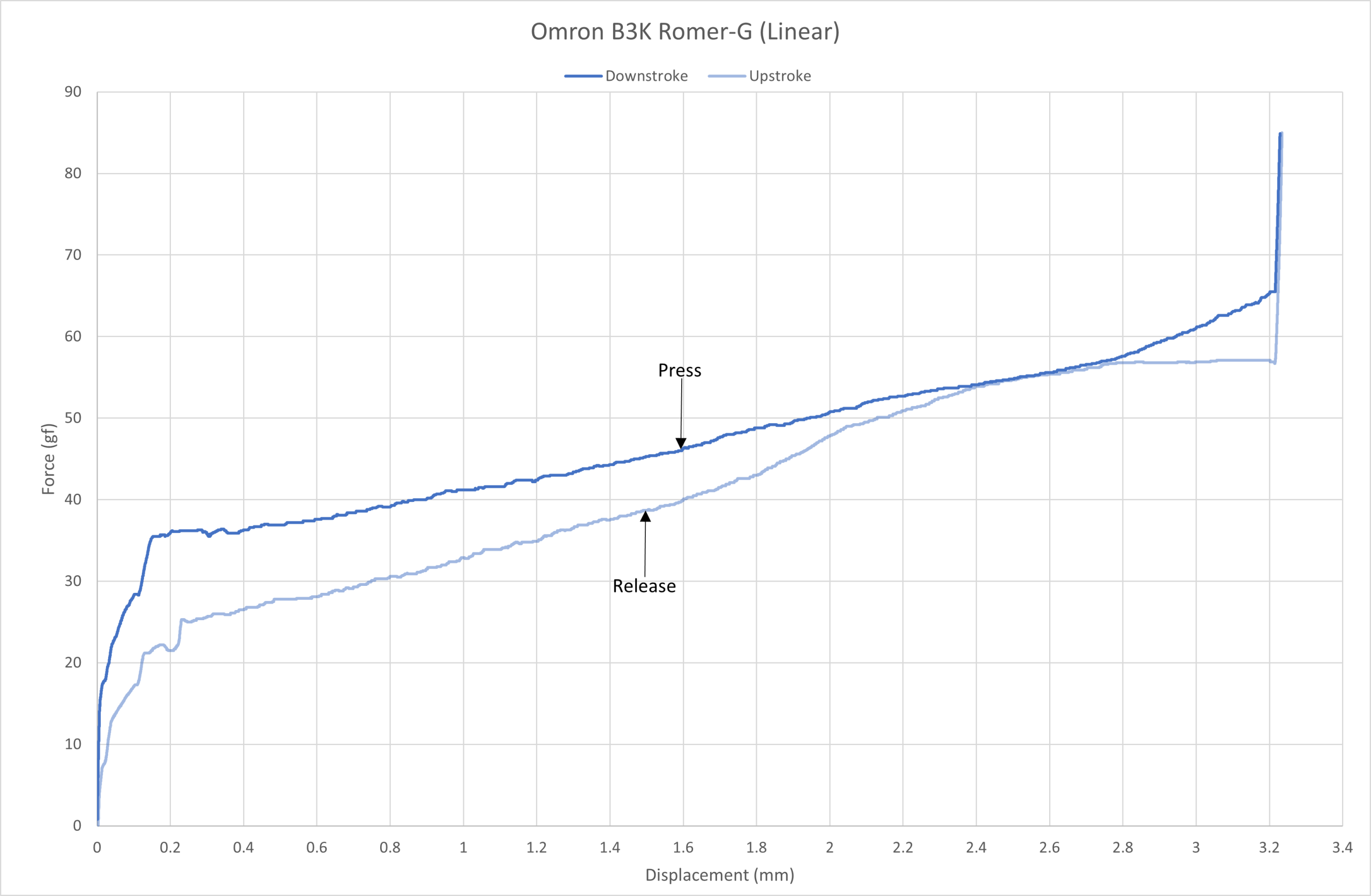
Omron B3K “Romer-G” Linear force curve.
As you can see from the force curve above, the Romer-G (Linear) is on spec in all areas.
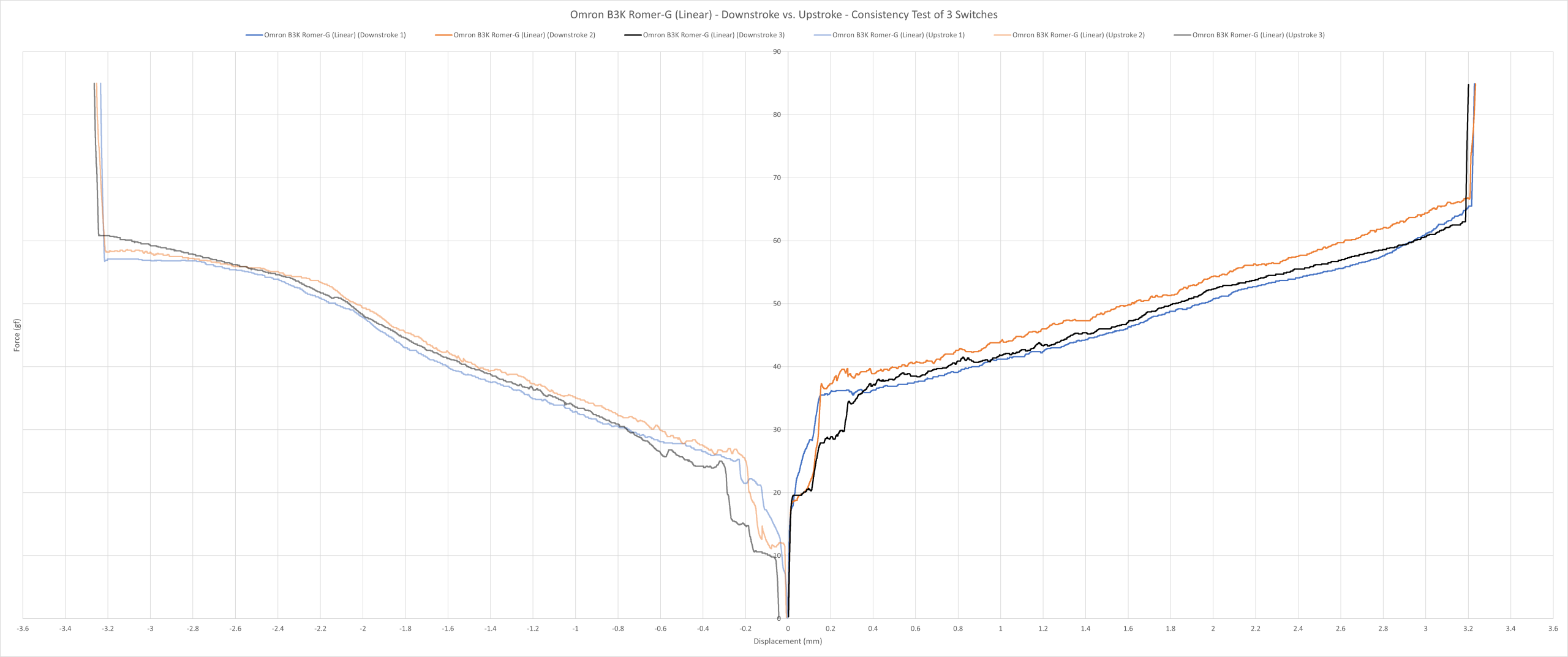
Omron B3K “Romer-G” Linear consistency force curve.
As you can see above, the switches are very inconsistent with weighting variances all around throughout travel, especially in the downstroke (right side).
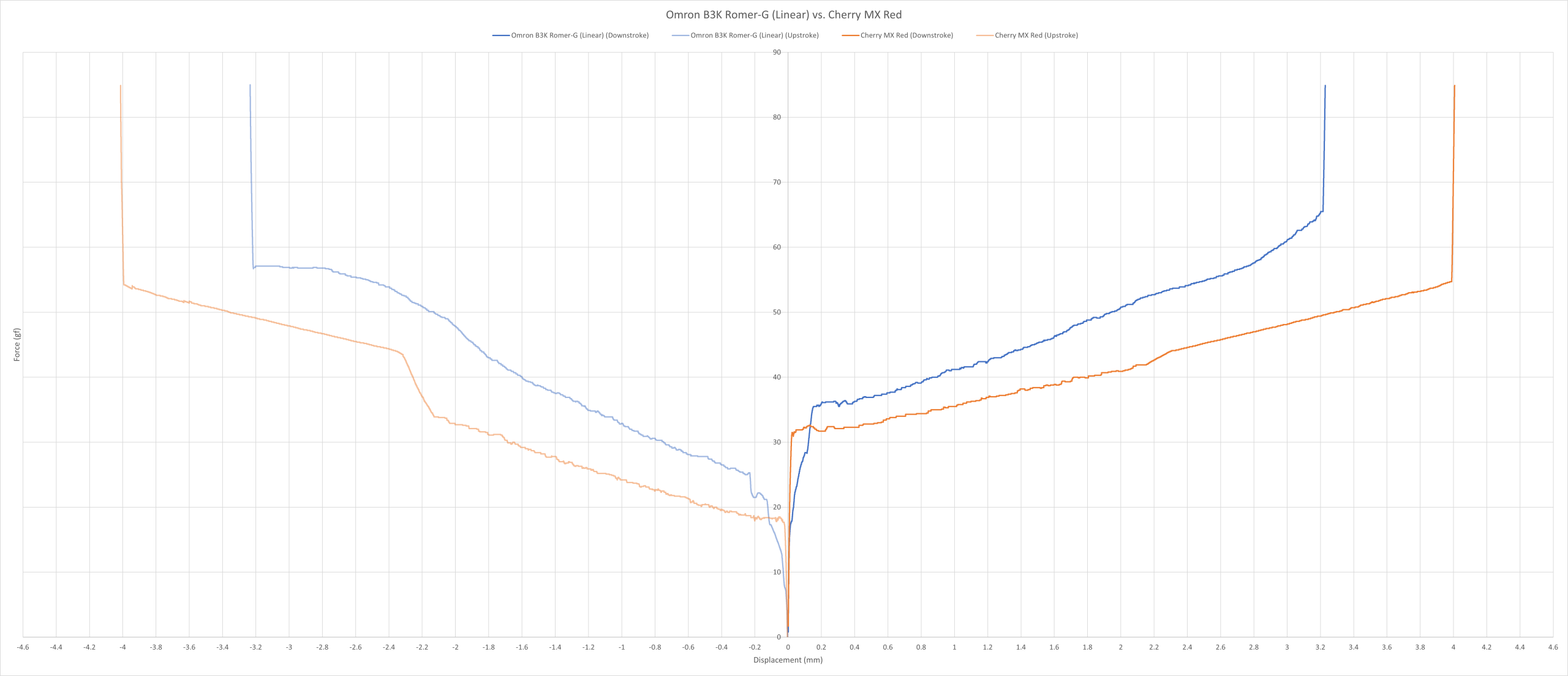
Omron B3K “Romer-G” Linear vs. Cherry MX Red force curve.
The force curve above shows the comparison between the Romer-G (Linear) and the Cherry MX Red. The Cherry switch starts off around 5g lighter and ending up around 10g lighter at the end of its travel. Additionally, the Romer-G has a shorter travel of around 3.3mm as opposed to the 4mm travel of the Cherry MX Red.
Much like the tactile variant, it appears that the Romer-G switch is the superior choice here, but this isn’t the case in practice.
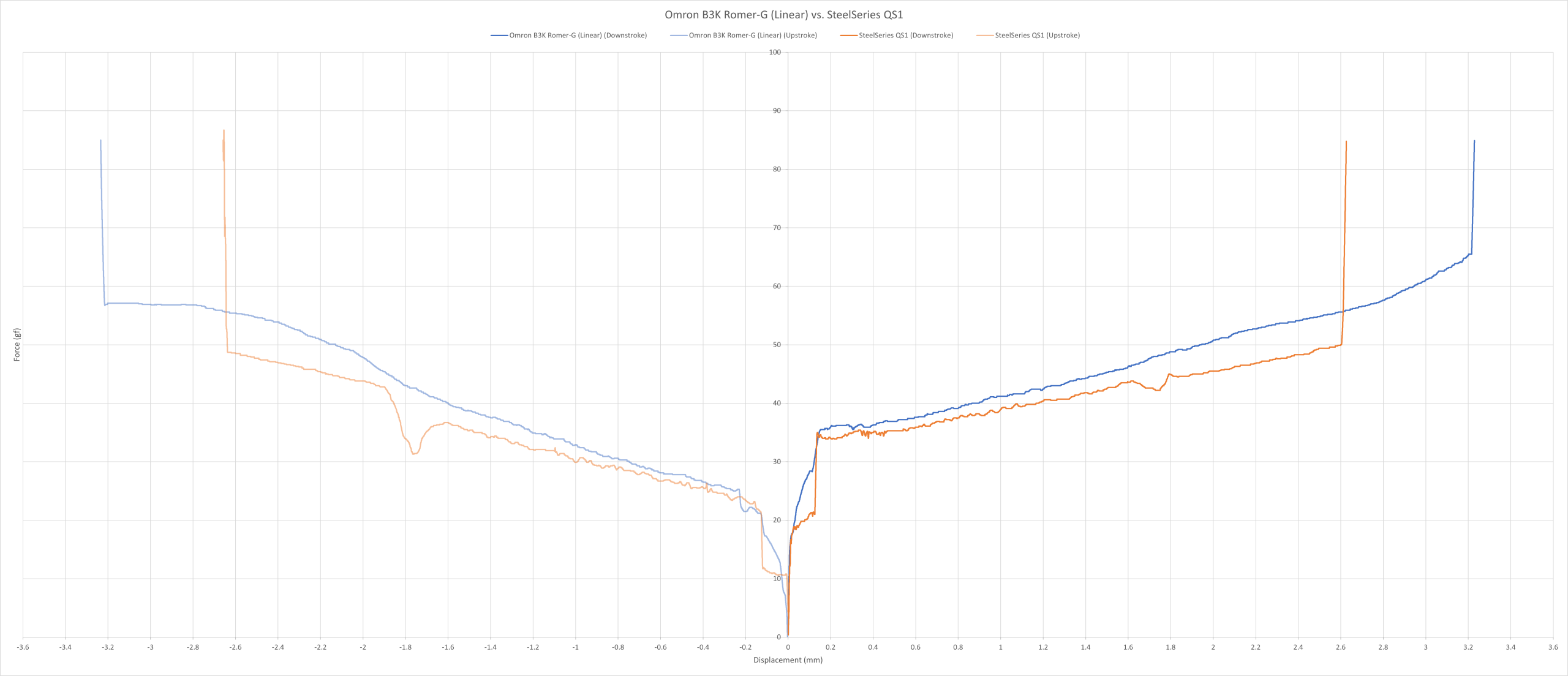
Omron B3K “Romer-G” Linear vs. SteelSeries QS1 force curve.
The force curve above shows the comparison between the Romer-G (Linear) and the SteelSeries QS1. Their weighting is similar to each other with less than a 5g difference for the majority of their travel. However, as a low-profile switch, the QS1 only has a 2.6mm travel, making the 3.2mm travel on the Romer-G look very long even though it’s shorter than many of its rivals.
Overall, they’re lightly weighted with consistency issues throughout – similar to the Cherry MX Red in many respects, but I do slightly prefer these as they’re a little heavier.
Sound: 5/10
Unlike the tactile variant, these aren’t as scratchy, and you therefore don’t hear much of their scratchiness. Although they still ping; and I’m led to believe this is caused by the switches and not the chassis as the G910 and G513 Carbon are built differently in this regard.
Overall, they have a clacky sound signature accompanied by an annoyingly rattily spacebar.
Typing Performance: 6/10
The market when this released was not filled with tough competition, but there was also no incentive to design anything new.
Although with that said, there were enough demands that Logitech made a linear variant of their successful Romer-G tactile switch. The result? It’s noticeably smoother than the Cherry MX Red – which doesn’t say much in today’s world, but was gaming changing then.
But how does that translate into typing? I hear you ask… Well, quite decently! Even though it has consistency issues, I didn’t find myself making too many typos, and this is despite the lighter than ideal weighting for my taste.
Overall, it’s smoother and more consistent than the Cherry MX Red, which helps in everyday typing. But unless you find an amazing deal on one of these, go and pick a better option on the current market.
Gaming Performance: 7/10
They have a few issues, making them not the ideal gaming switch.
Firstly, they’re a little inaccurate for slower-paced games. This is because of their inconsistencies, making them more difficult to use and judge in bullet-hell games, as an example. It’s not the end of the world, but this is one of its biggest downsides.
Additionally, even in fast-paced games, I can still feel slight scratchiness here and there, which again isn’t ideal, especially when you’re trying to really concentrate, but this is a minor issue.
Overall, I would still say that there are good switches for gaming if you’re not in the competitive space or if you aren’t playing anything too demanding, but want an upgrade from rubber domes. Otherwise, there are plenty of better options out there.
Final Score = 30/50 (60%)