
| Switch Type: Linear |
| Actuation Point (mm): | 1.2 | Actuation Point (mm): | 0.94 |
| Actuation Force (gf): | 45 | Actuation Force (gf): | 37.9 |
| Total Travel (mm): | 3.5 | Total Travel (mm): | 3.42 |
| Reset Point (mm): | 1.0 | Reset Point (mm): | 0.91 |
| Bottom-out Force (gf): | 60 | Bottom-out Force (gf): | 59.8 |
TL;DR
They’re very smooth, consistently performing, lightly weighted switches with an incredibly high actuation point. In fact, most of the switches actuated higher than the stated 1.0mm mark. So yes, they’re ultra sensitive. And no, they aren’t adjustable; so, typos galore.
Smoothness: 10/10
On-centre keypresses are ultra smooth with ZERO scratchiness and inconsistencies even at very slow keypresses.
Off-centre keypresses are extremely smooth with almost zero scratchiness or inconsistencies even at very slow keypresses.
Overall, and perhaps unsurprisingly, these are among the smoothest switches on the market. But, these would be difficult to buy separately since these they’re propriety switches.
Weighting: 3/10
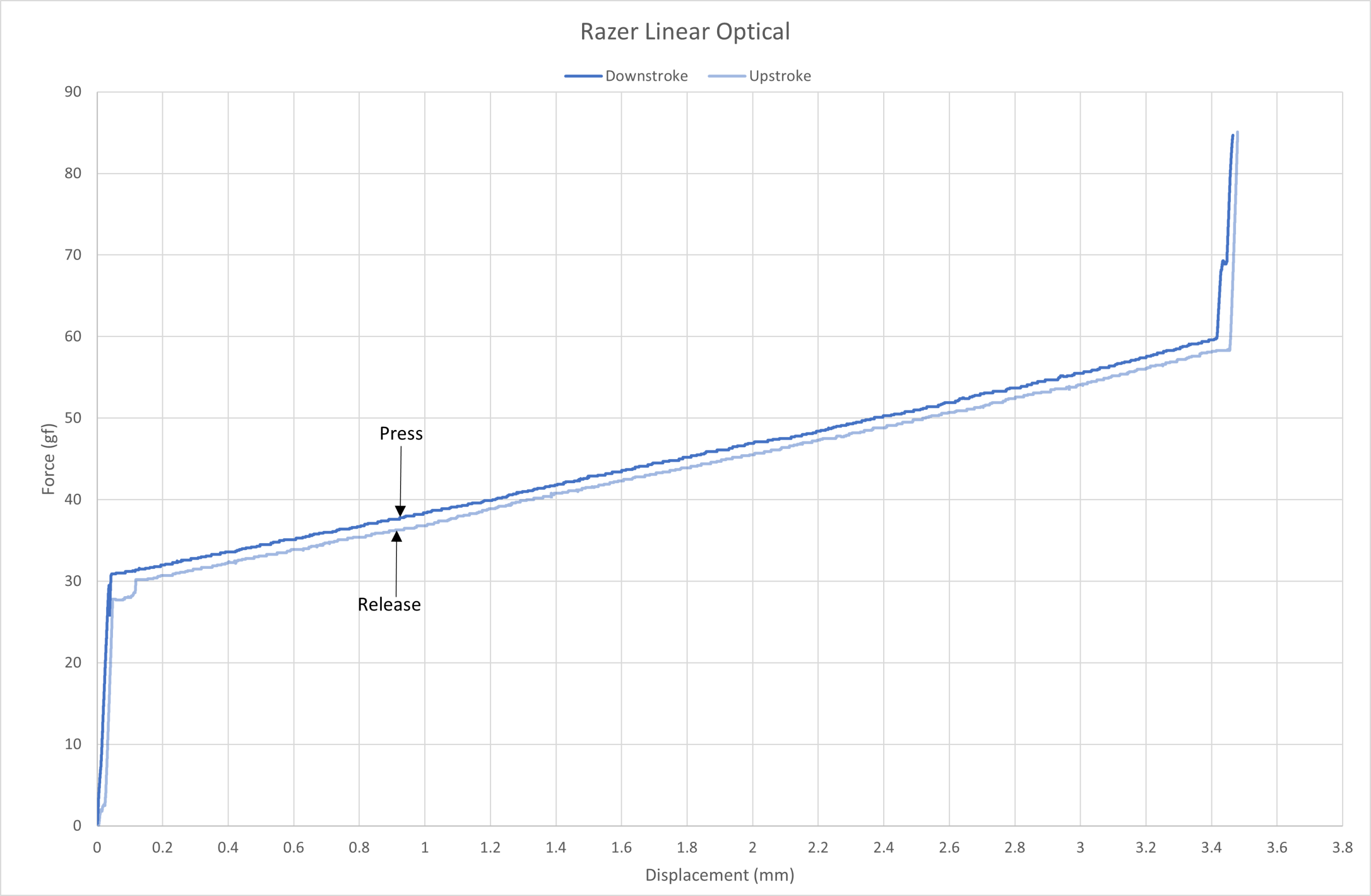
Now, according to Razer these switches have an actuation force of 45g at 1.2mm and a bottom-out force of 60g at 3.5mm.
Razer Linear Optical force curve.
As you can see from the force curve above, the Razer Linear Optical is on spec apart from its actuation force which is closer to 38g than 45g; this is outside tolerance in many cases.
Razer Linear Optical consistency force curve.
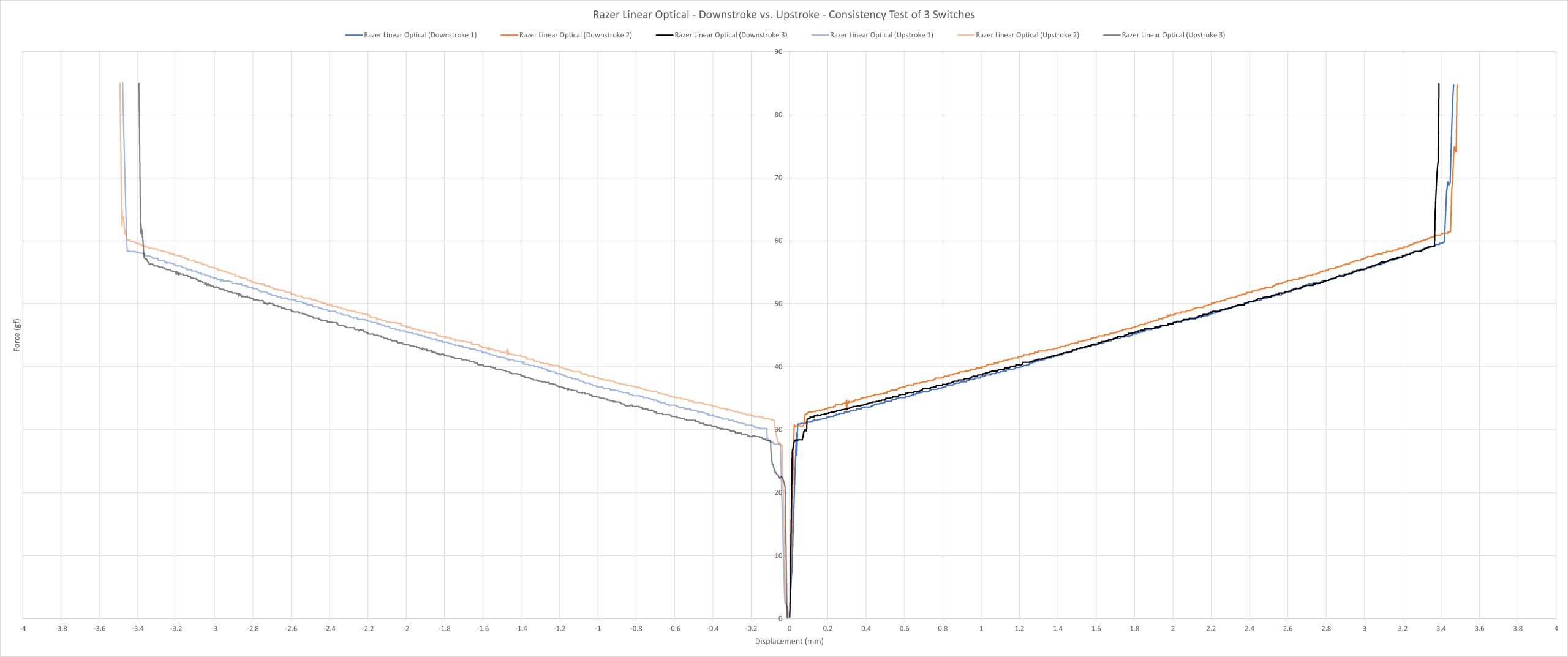
As you can see above, the switches are very consistent with only very minor variances between them.
Razer Linear Optical vs. Cherry MX Red force curve.
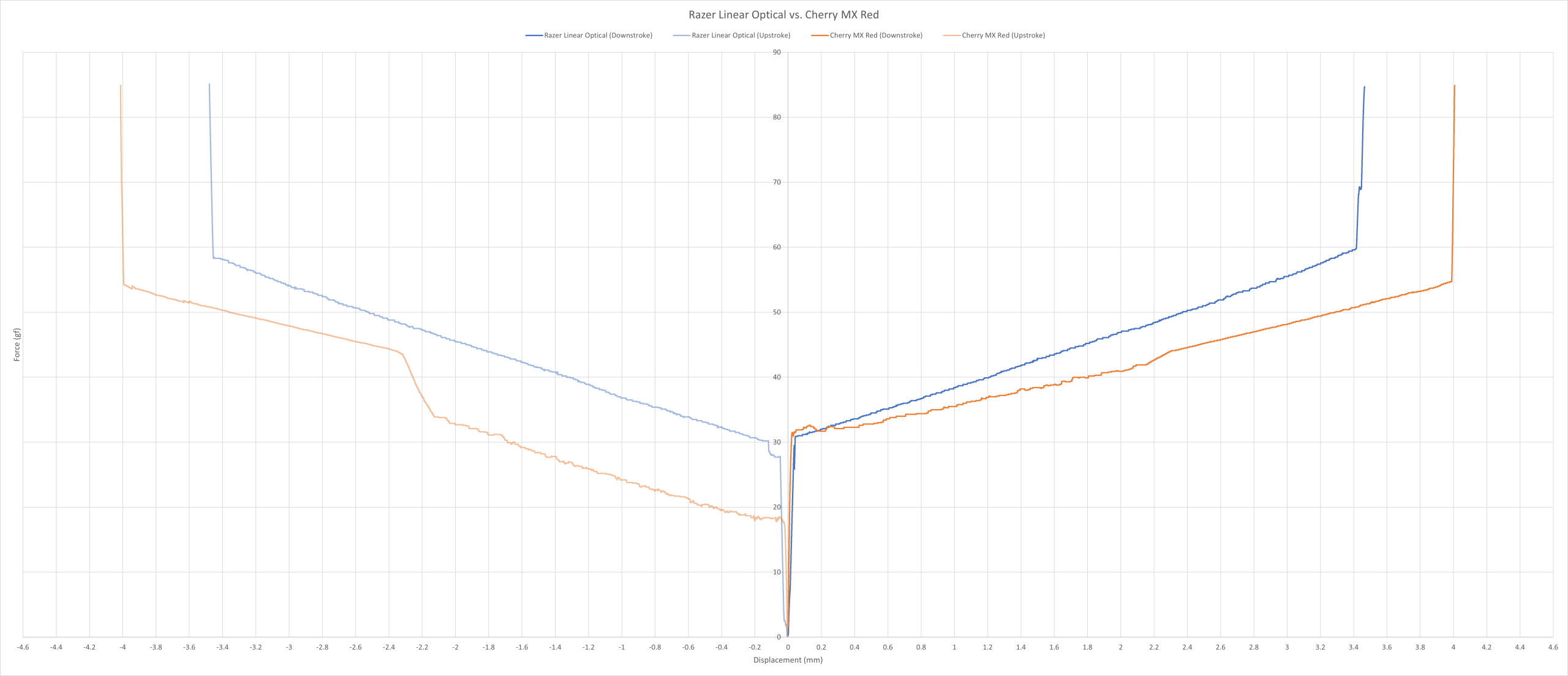
The force curve above shows the comparison between the Razer Linear Optical and the Cherry MX Red. They both start at around 30g, but there is roughly a 5g difference between them bottomed-out.
Razer Linear Optical vs. Roccat Titan Optical (Linear) force curve.
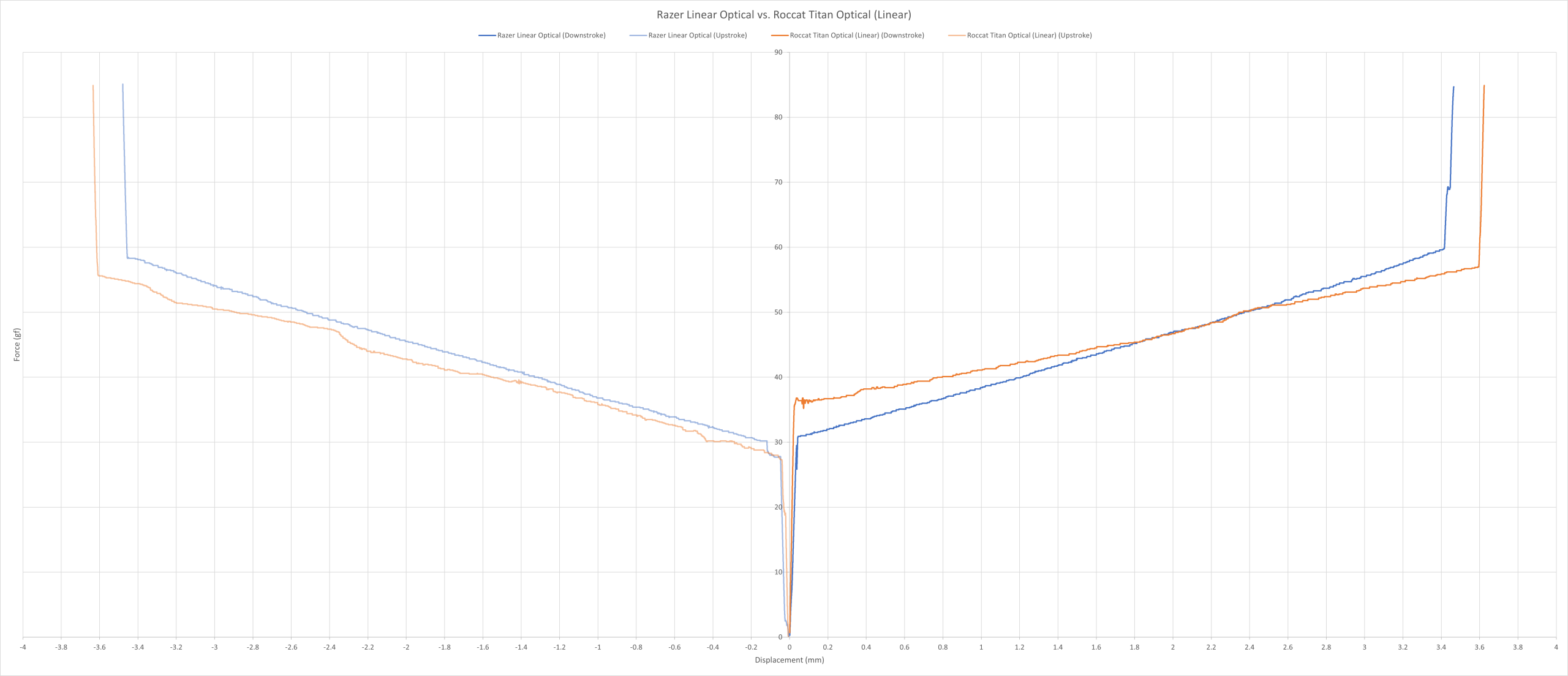
The force curve above shows the comparison between the Razer Linear Optical and the Roccat Titan Optical Linear. While the Titan switch starts off roughly 7g heavier, it bottoms-out around 3g lighter than the Razer switch. Plus, both switches have an identical weighting from 1.8 – 2.5mm on the downstroke.
Overall, these are lightly switches with an incredibly high actuation point (most being less than 1.0mm). But they’re extremely consistent.
Sound: 6/10
They’re loud and feature a somewhat tinny sounding signature to them. Perhaps, the keycaps could be the culprit here, as they’re made of PBT, which have never really been renowned for their acoustics, and the switches are mounted in a ‘floating case’ design, which historically has also not been great for sound.
Overall, they’re decent. Although, the rattle from each switch stabilizer may bother you.
Typing Performance: 3/10
Just like with many gaming focused switches, these weren’t designed for typing in the slightest. They actuate too high for the majority of typists. In my case, I many lots of typos from too many accidental keypresses.
The only thing this switch has going for it, is its top-level smoothness and extremely consistent performance. So yes, it’s not all just downs, even though it mostly is.
Overall, it would’ve been great if Razer made these adjustable to suit typists, then again, not many would buy a Razer keyboard as a productivity tool.
Gaming Performance: 7/10
These performed exceptionally well in slow-paced games. I could accurately pinpoint where I wanted to be with only the slightest touch. Although, it would’ve been nice if it was less sensitive.
Unfortunately, I just couldn’t bring myself to liking these in fast-paced games. They’re simply far too sensitive! Plus, it’s light weighting made if hard for me to have any reasonable control – it’s the worst of both worlds for me – a light weighting and a high actuation point.
Overall, despite that, I still enjoyed gaming on them as they were ultra smooth and extremely consistent throughout – that, I cannot fault.
Final Score = 29/50 (58%)