
| Switch Type: Linear | Mount: Plate Mount (3-pin) | Spring: Single Stage | Price: £24.99 (36pcs) on Razer |
| Factory Lubed: Yes |
| Actuation Point (mm): | 1.2 | Actuation Point (mm): | 1.71 |
| Actuation Force (gf): | 45 | Actuation Force (gf): | 44.8 |
| Total Travel (mm): | 3.5 | Total Travel (mm): | 3.27 |
| Reset Point (mm): | 1.2 | Reset Point (mm): | 1.68 |
| Bottom-out Force (gf): | Bottom-out Force (gf): | 53.7 | |
| Stem Length (mm): | 12.73 | ||
TL;DR
I’m slightly confused as to why the Razer Yellow exists in the modern world. It doesn’t seem to have been designed to excel in gaming (at least according to my testing). Plus, many wouldn’t consider it to be a ‘typist’ switch. The Razer Yellow sits in a weird position, and especially more so considering its high price tag.
Additionally, these switches have sound dampeners. Yes, they feel mushy, but not as mushy when compared to traditionally silenced switches. But they’re also not as quiet – I’d say these switches are only about 30% quieter compared to non-silenced switches.
Smoothness: 7/10
On-centre keypresses are very smooth with only minor inconsistencies at very slow keypresses.
Off-center keypresses are fairly smooth with fair to moderate levels of scratchiness at slow keypresses.
Overall, these are noticeably scratchier and slightly more inconsistent in key feel when compared to its tactile counterpart – the Razer Orange; it’s not by much, but enough that the score is dropped by one point.
Side note: These are factory lubed with GPL 205g0

Razer Yellow (Gen-3) switch disassembled.
Weighting: 6/10
Now, according to Razer these switches have an actuation force of 45g at 1.2mm and a total travel of 3.5mm.
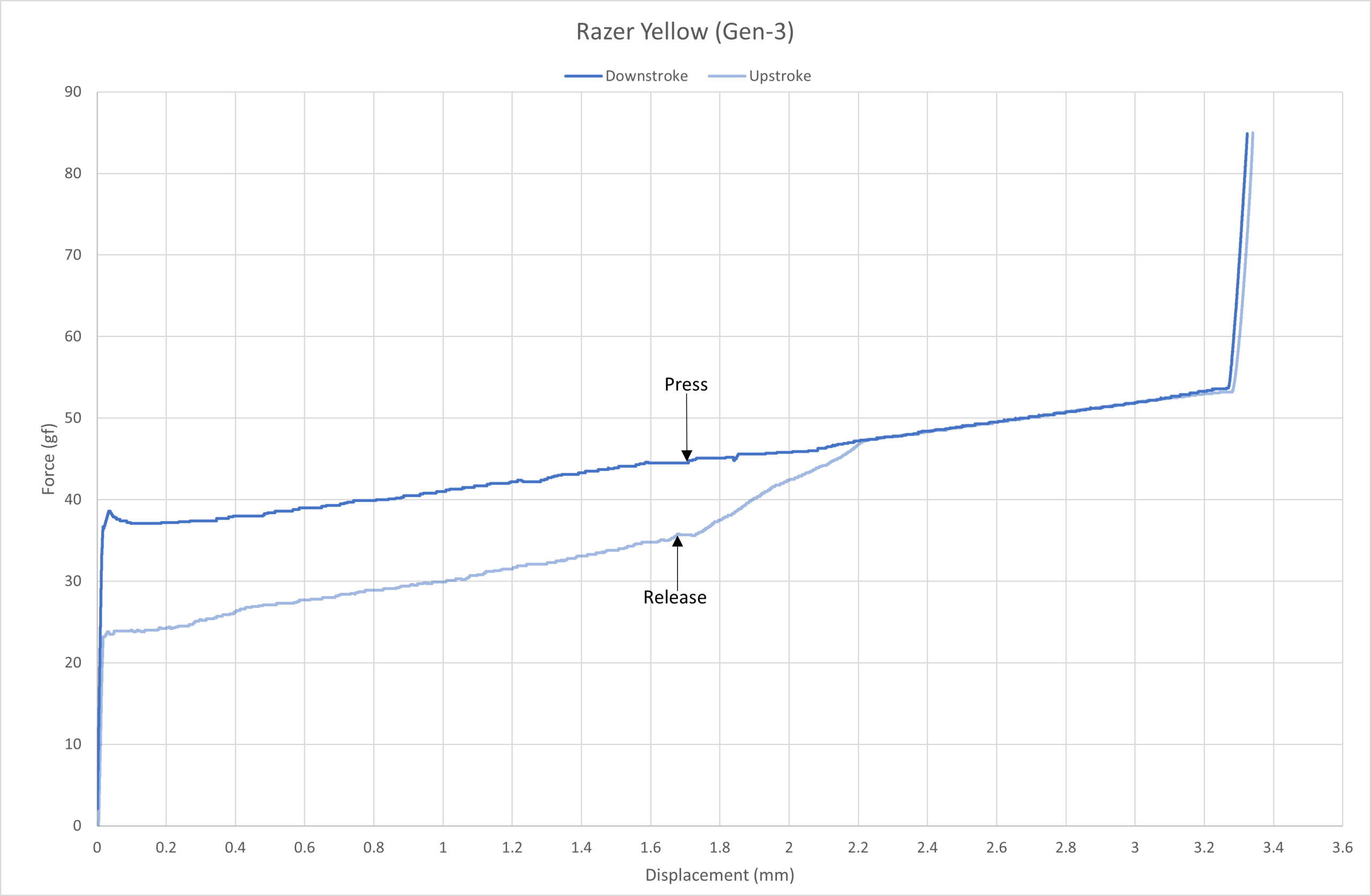
Razer Yellow (Gen-3) force curve.
As you can see from the force curve above, the Razer Yellow (Gen-3) is on spec apart from its actuation and reset point. Razer states that the actuation and reset point are both at 1.2mm. However, this is closer to 1.7mm in practice.

Razer Yellow (Gen-3) consistency force curve.
As you can see above, the switches are very consistent. Although, Switch 3 is ever so slightly shorter in comparison to the other two. Plus, Switch 2 has a lower force on the upstroke from around 1.6 to 2.2mm.
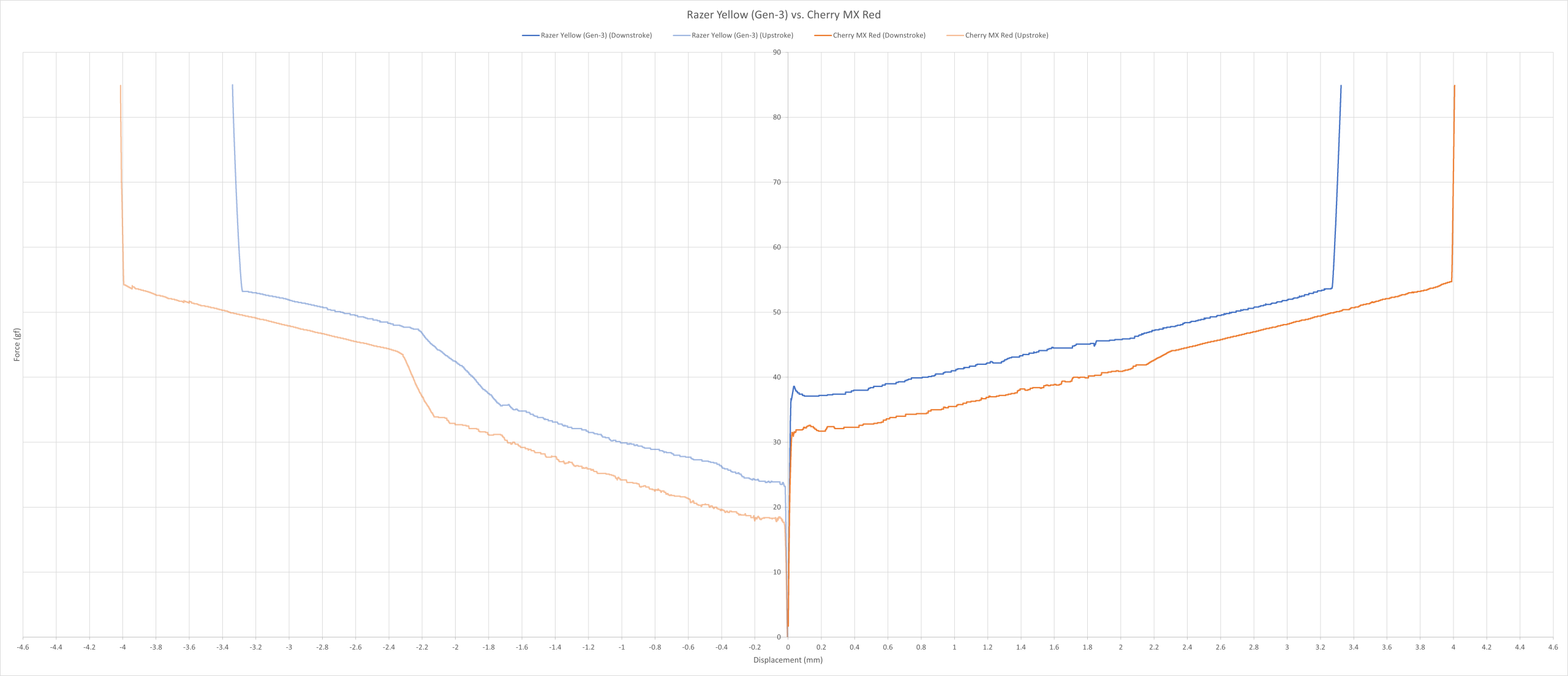
Razer Yellow (Gen-3) vs. Cherry MX Red force curve.
The force curve above shows the comparison between the Razer Yellow (Gen-3) and the Cherry MX Red. It’s clear that the MX Red is roughly 5-8 grams lighter and has around a 0.7mm longer travel.
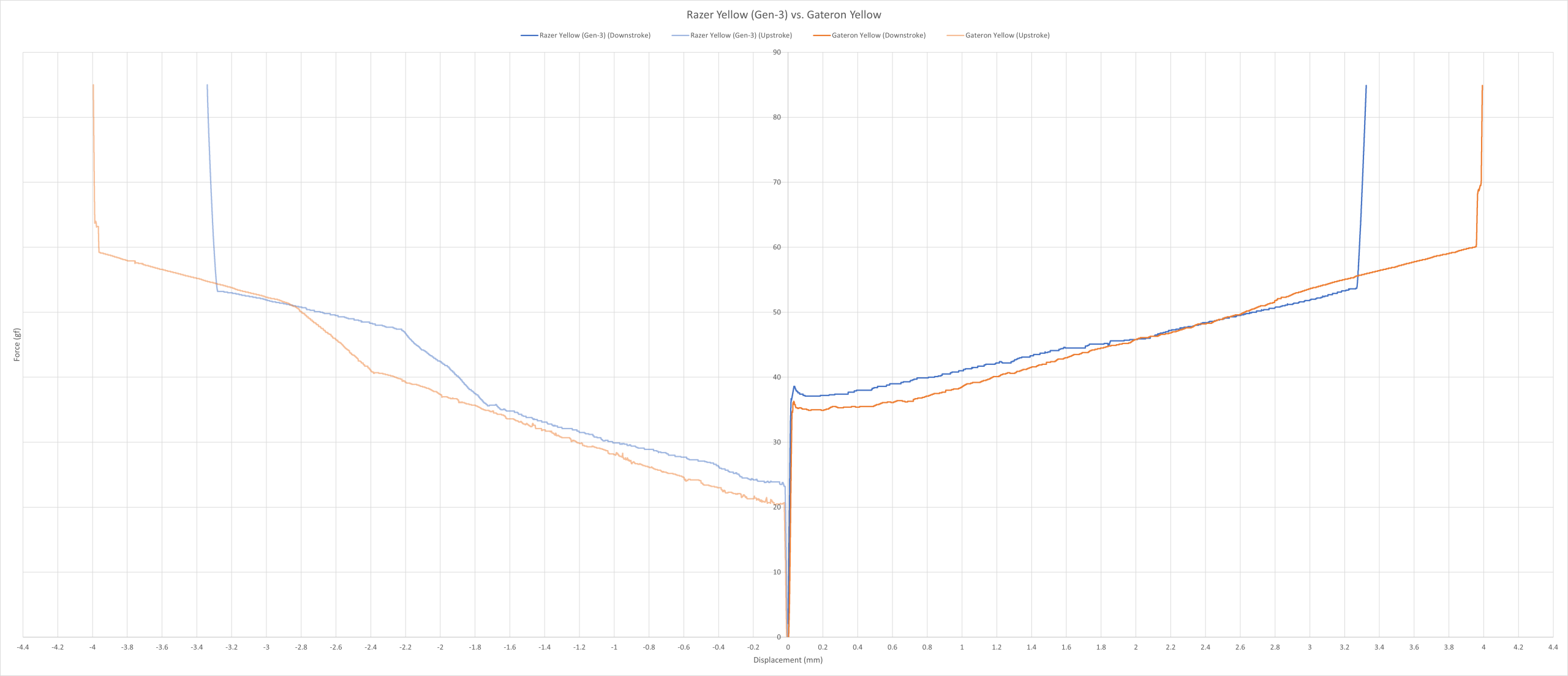
Razer Yellow (Gen-3) vs. Gateron Yellow force curve.
The force curve above shows the comparison between the Razer Yellow (Gen-3) and the Gateron Yellow. This is a much closer comparison as they have a similar weighting. Although the Gateron Yellow has a total travel of 4mm.
Overall, while I found the weighting to be too light for my tastes, these performed consistently with no major issues. I think Razer has done a good job here as it targets the Gateron Yellow – a very popular switch. Plus, it isn’t too far off of a Cherry MX Red.
Sound: 6/10
Unlike its tactile counterpart, these Yellow switches don’t quite have the same ‘punch’ and fullness. They sound rather… hollow. They do still sound clacky, though.
Additionally, they’re also dampened, and a of its sound comes from the upstroke – this isn’t a bad thing per se, I’m just not a big fan of it.
Overall, unless you like the sound signature of a silenced switch, it’s a downgrade in the sound department.
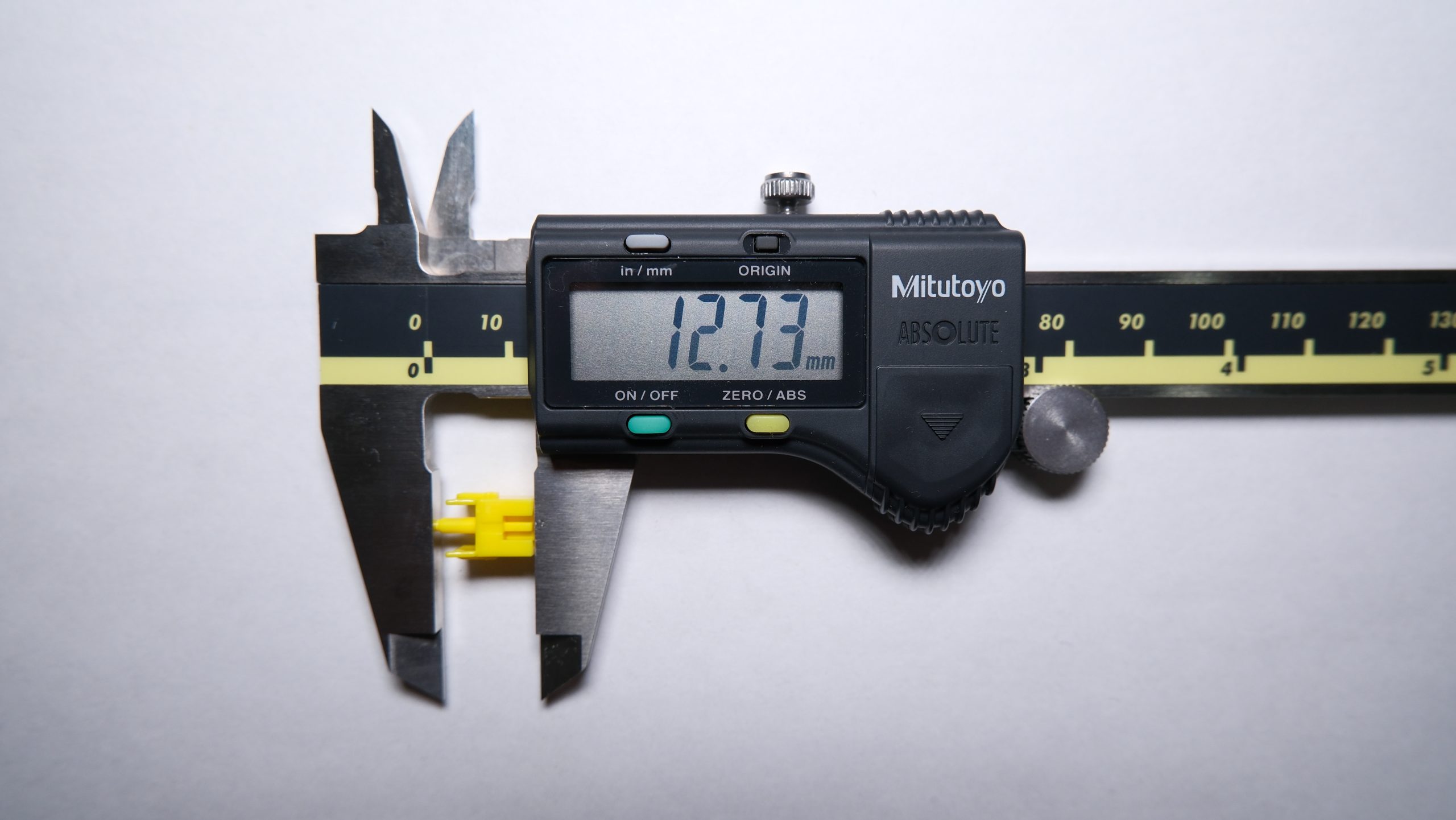
The Razer Yellow (Gen-3) stem length is 12.73mm.
Typing Performance: 6/10
These switches have dampeners in them, but they’re possibly the loudest ‘quiet’ switch I’ve ever tested.
However, they’re also the least mushy feeling. So, a compromise needs to be made. You’re choosing to either prioritise key feel or quietness. Unfortunately, we still cannot have both (yet).
So, what do they actually feel like when typing? Well, think of a traditionally silenced switch like the Cherry MX Silent Red, but with 70% of the mushiness gone – that’s what these Yellow switches feel like.
Although, unlike the Cherry MX Silent Red, these switches aren’t as scratchy. They’ve also performed very consistently throughout my testing.
Overall, even though they aren’t as mushy feeling when compared to most silenced switches, I still don’t like how they feel. You’ve also got to remember that I’m not a fan of its weighting – at least they’re fairly smooth and consistent, so there’s that going for it.
Gaming Performance: 7/10
Its mushy feel will definitely split opinions here. There will be gamers out there who’ll appreciate its quieter nature, but there will be those who are expecting a more traditional MX linear switch key feel.
However, in terms of performance, they’re pretty good for fast-paced games. I couldn’t feel any scratchiness that would hinder my gameplay. However, their scratchiness is slightly more noticeable during slower-paced games – I’m nitpicking here, but I’m sure that’s what you came here for!
Overall, these wouldn’t be my top choice, but they’ve performed very well many gaming scenarios. If you don’t mind a slightly mushy key feel and a quieter sound signature, this is a solid pick.
Final Score = 32/50 (64%)
Places to purchase this switch:
Razer | Currys | Overclockers UK