
| Switch Type: Linear | Mount: PCB Mount (5-pin) | Spring: Single Stage | Price: £18 (100pcs) on Akko |
| Top Housing: POM | Bottom Housing: PA66 | Stem: POM | Factory Lubed: Yes |
| Actuation Point (mm): | 2.0 ± 0.4 | Actuation Point (mm): | 1.95 |
| Actuation Force (gf): | 45 ± 8 | Actuation Force (gf): | 46.9 |
| Total Travel (mm): | 3.6 ± 0.4 | Total Travel (mm): | 3.43 |
| Reset Point (mm): | 1.9 | Reset Point (mm): | 1.95 |
| Bottom-out Force (gf): | 55 ± 8 | Bottom-out Force (gf): | 49.9 |
| Stem Length (mm): | 13.44 | ||
DISCLAIMER | Please Read:
These switches were sent by Akko for review and testing purposes. No one paid me to write this review, and impartiality will always be a top priority here at KeebWorks.
TL;DR
This switch is meant to bring the good qualities of both the Akko Creamy Yellow Pro (V5) and the Akko V3 Cream Yellow – two of which are already pretty decent switches.
Although, I’m still wondering what the true purpose of this switch is – it’s VERY similar to the already existing Akko Creamy Yellow Pro (V5), but at a much better value.
Smoothness: 7/10
On-centre keypresses are decently smooth, with noticeable scratchiness at very slow keypresses.
Off-centre keypresses are reasonably smooth, but the scratchiness is more noticeable at slower keypresses.
Overall, with the dawn of HE switches, these certainly pale in comparison, but it does pretty well against its contemporaries.
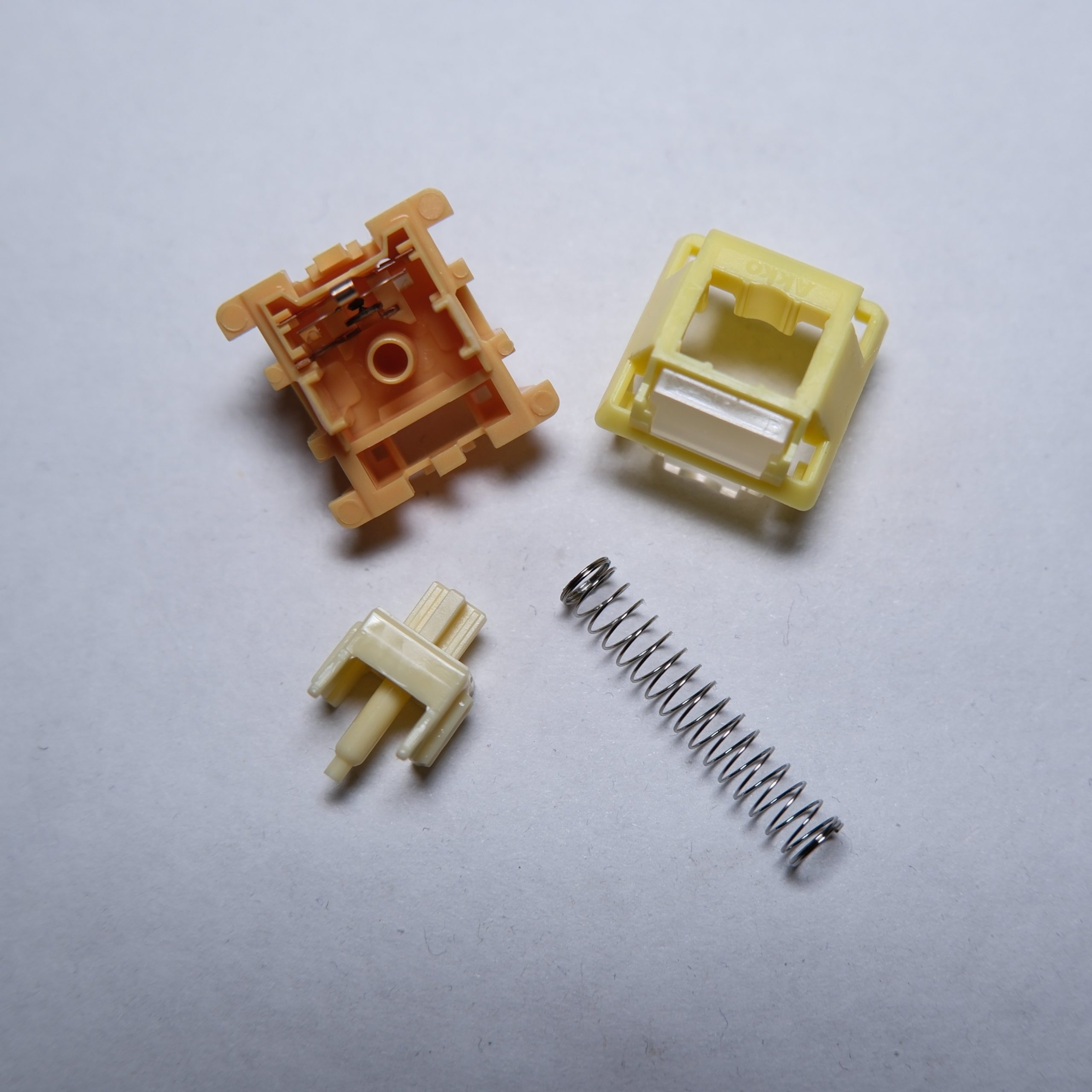
Akko Creamy Yellow U1 switch disassembled.
Weighting: 7/10
Now, according to Akko these switches have an actuation force of 45g at 2.0mm and a total travel of 3.6mm, bottoming-out at 50g.
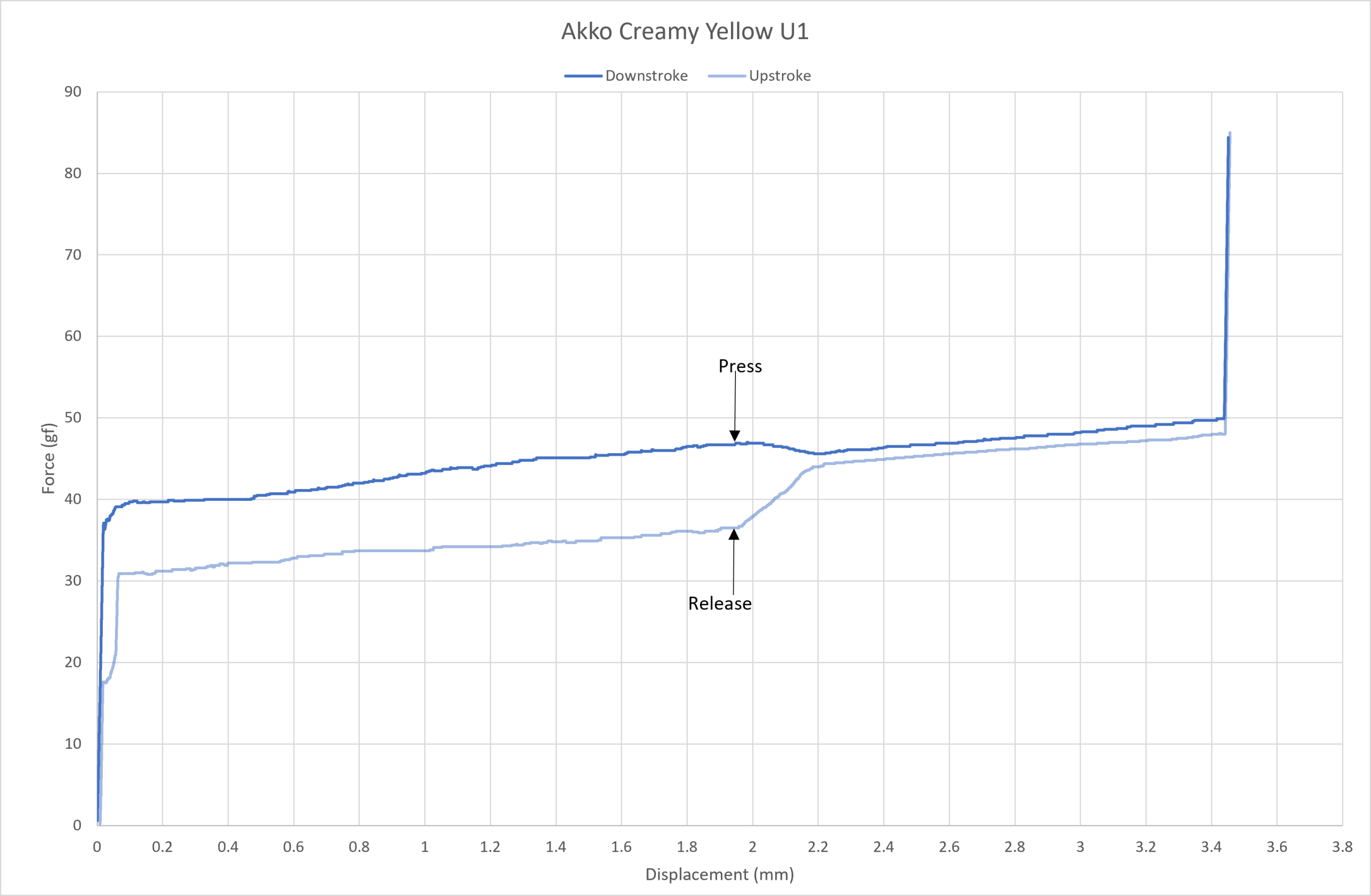
Akko Creamy Yellow U1 force curve.
As you can see from the force curve above, the Akko Creamy Yellow U1 is on spec in all areas.
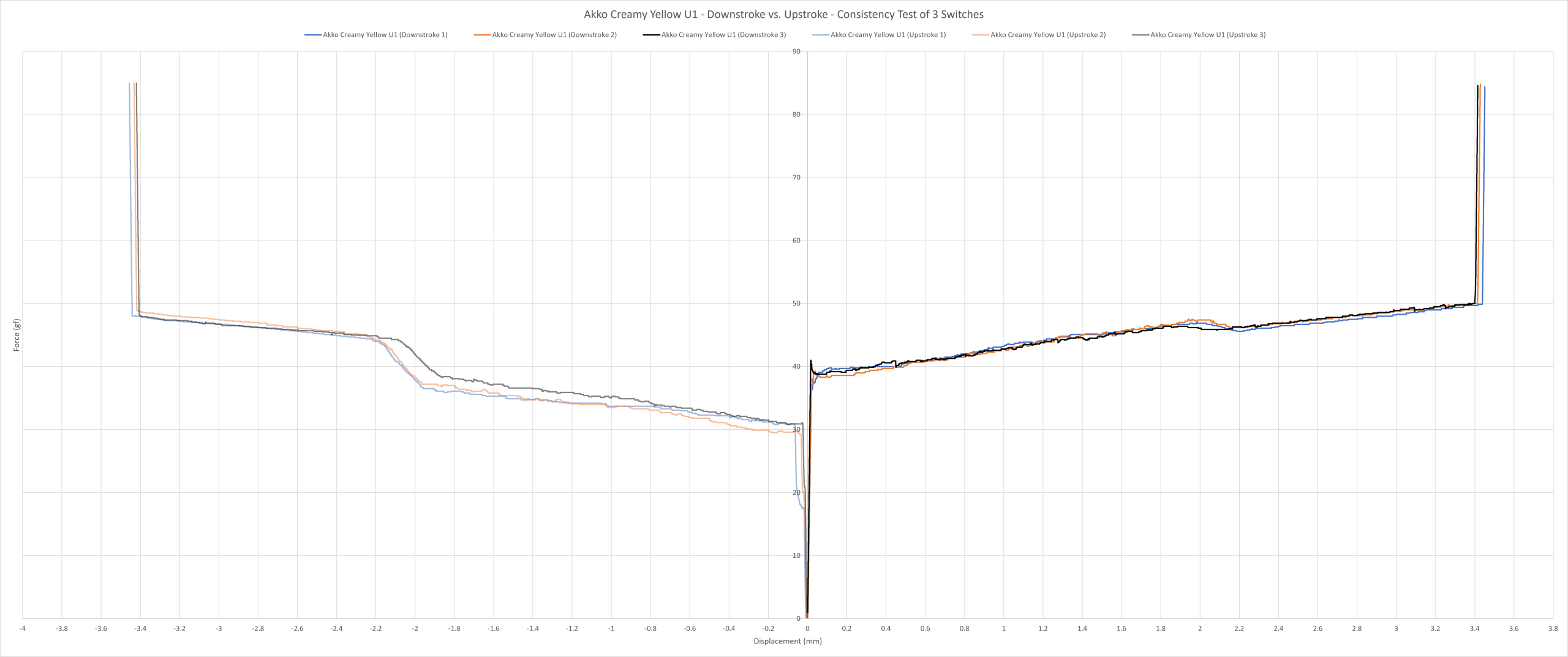
Akko Creamy Yellow U1 consistency force curve.
As you can see above, the switches are extremely consistent with only slight weighting variances between the 3 switches, especially on the downstroke.
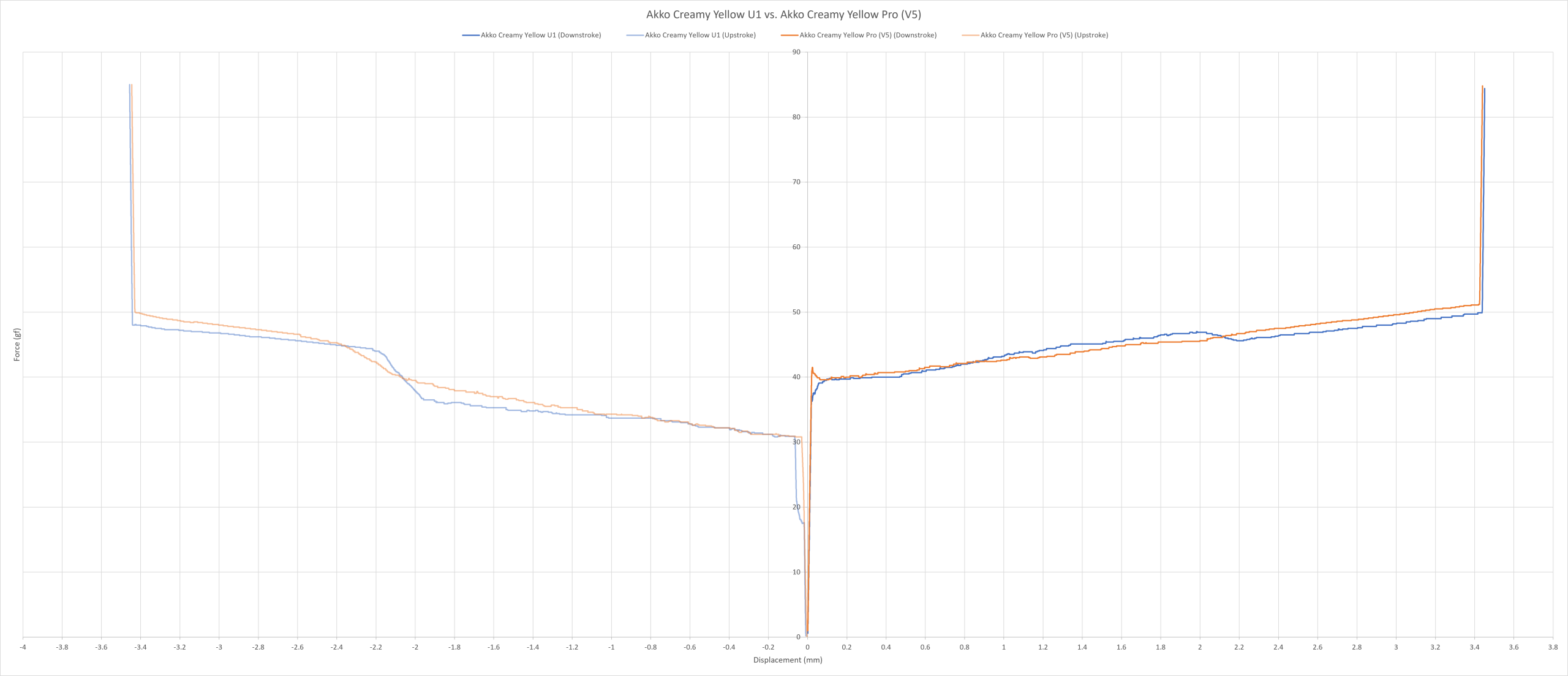
Akko Creamy Yellow U1 vs. Akko Creamy Yellow Pro (V5) force curve.
The force curve above shows the comparison between the Akko Creamy Yellow U1 and the Akko Creamy Yellow Pro (V5). These two switches are essentially identical on the graph, and is the number one reason I don’t understand the existence of the U1 switch.
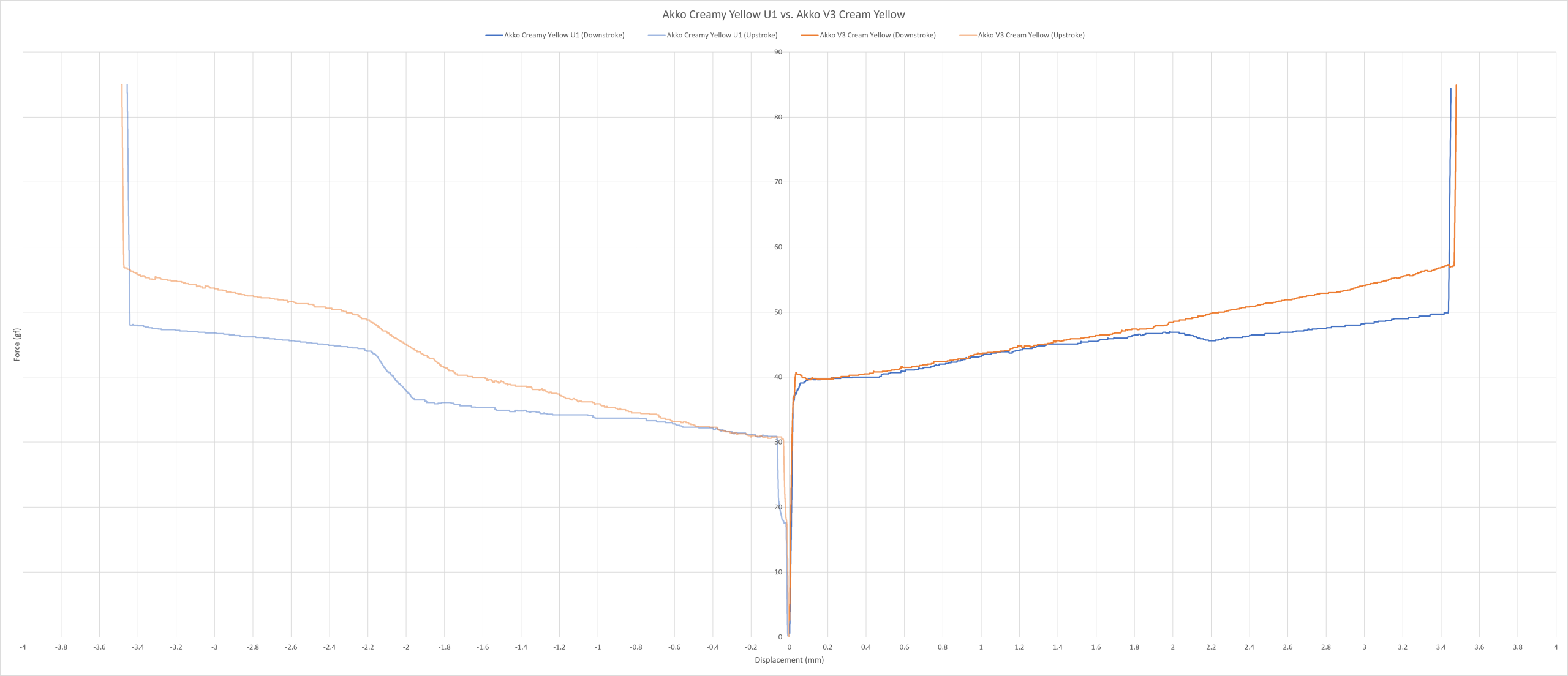
Akko Creamy Yellow U1 vs. Akko V3 Cream Yellow force curve.
The force curve above shows the comparison between the Akko Creamy Yellow U1 and the Akko V3 Cream Yellow. Similarly, with the V5, the V3 is also almost identical to the U1, but the U1 is overall lighter than the V3 upstroke wise.
Overall, these are extremely consistent, light-medium weighted linear switches. These perform almost identically to previous Akko ‘Yellow’ switches. Akko did not intend them as an upgrade, but rather as an excellent value switch for those upgrading from a rubber dome or an older (crappier) keyboard.
Sound: 8/10
I think Akko has nailed the sound of these switches; they clacky as the Akko Mineral 01 is an aluminium keyboard.
Overall, I could sometimes hear some scratchiness, but even with this in mind, I still really like how pleasant they sound on the Akko Mineral 01.
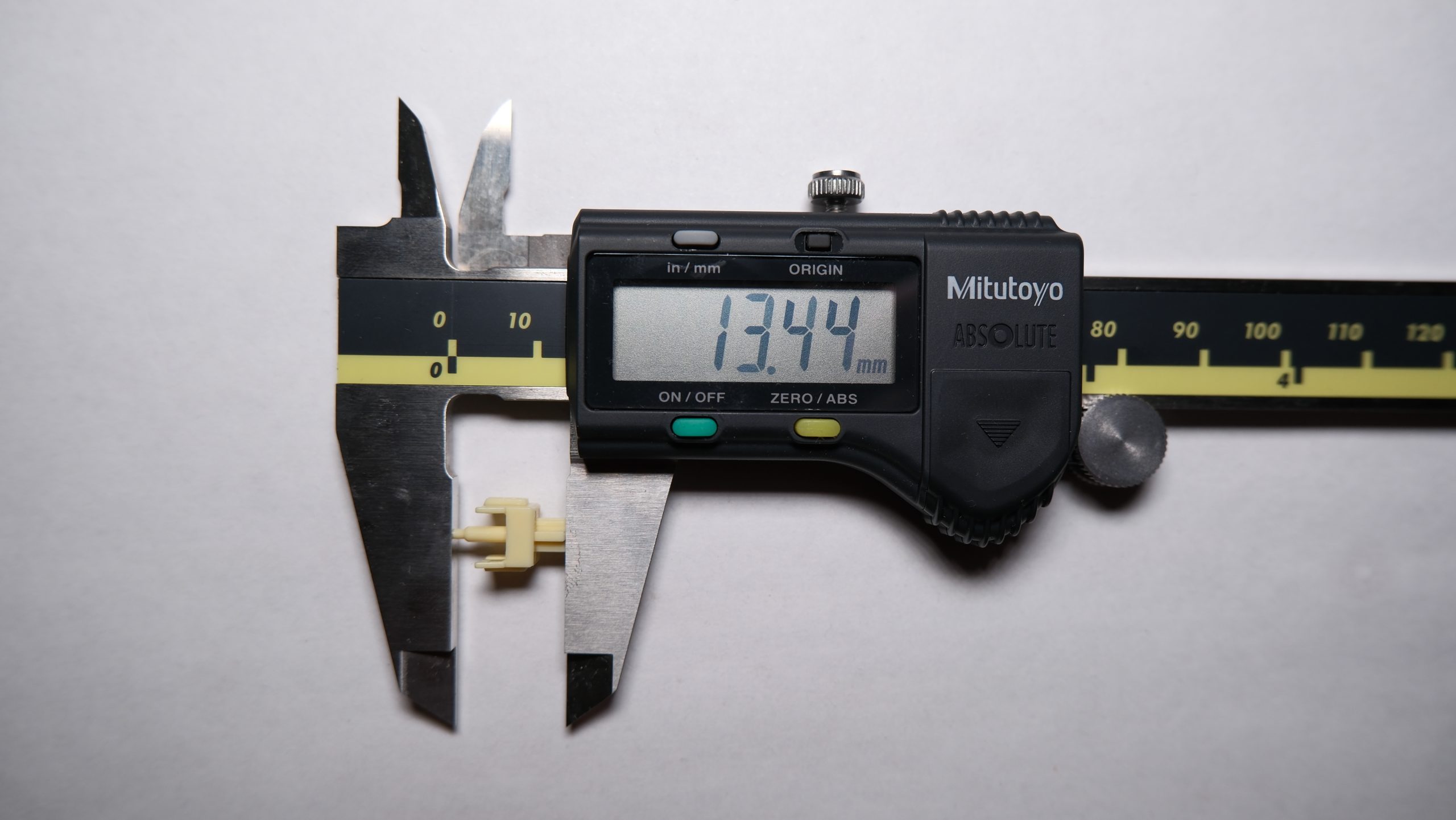
The Akko Creamy Yellow U1 stem length is 13.44mm.
Typing Performance: 8/10
As with many of Akko’s switches, these are not be my preferred weighting, but they’re so consistent, I can type on these and be happy with them.
I barely made any typos during my time testing these, so that’s always a positive. They were also very smooth and consistent throughout too.
Overall, if you’re a fan of switches like the Cherry MX Red or the Gateron Yellow, I think you would really like these switches. They’re also factory lubed.
Gaming Performance: 8/10
They had very slight nags in both fast and slow-paced games, but thankfully too serious.
The biggest issue they had was that they feel like they hesitate ever so slightly when making very precise movements. This could be due to the lubrication, but with that aside, they performed very well with no other complaints from me.
Overall, these will make for a solid gaming switch regardless of what you’re playing. Plus, they’re currently going for £16 for 100 switches. That’s cheaper than 95% of switches on the market. Talk about value for money!
Final Score = 38/50 (76%)